Want the full research and a practical GEO playbook?
This public article deliberately withholds the target domain and some research details. It shares the main findings; I have put the deeper case study, keyword research methods, and implementation materials into Recommended by ChatGPT Within 18 Hours: A Practical GEO Playbook for Trending Queries.
**The Chinese-language PDF has 39 pages, four practical templates, and a one-page launch checklist.**It goes further into search experiments, trend analysis, page structure, and measuring AI referrals—for readers who want to move from understanding the case to testing the approach.

The PDF is not available for public download. Scan the WeChat QR code at the end of this article to add me, and include “GEO handbook” in your request to ask about the contents and purchasing options.
On September 29, GeFei posted that a website he had launched at 11 p.m. the previous night was already receiving a steady stream of visitors from ChatGPT. He felt he had discovered the secret to GEO, or generative engine optimization.
His screenshot showed a short sequence of visits between 4:51 and 5:14 p.m. Almost every recorded source was chatgpt.com; Google appeared only twice.

Two days later, he said revenue had exceeded $2,000 with “zero traffic cost” up to that point. That was his public claim, rather than an independently audited account of total acquisition costs.
The post pointed to TrustMRR, which connects to Stripe to verify revenue. The project was in Stealth mode: revenue was visible, but its domain was hidden. Its description read “AI Video Maker By GeFei.”
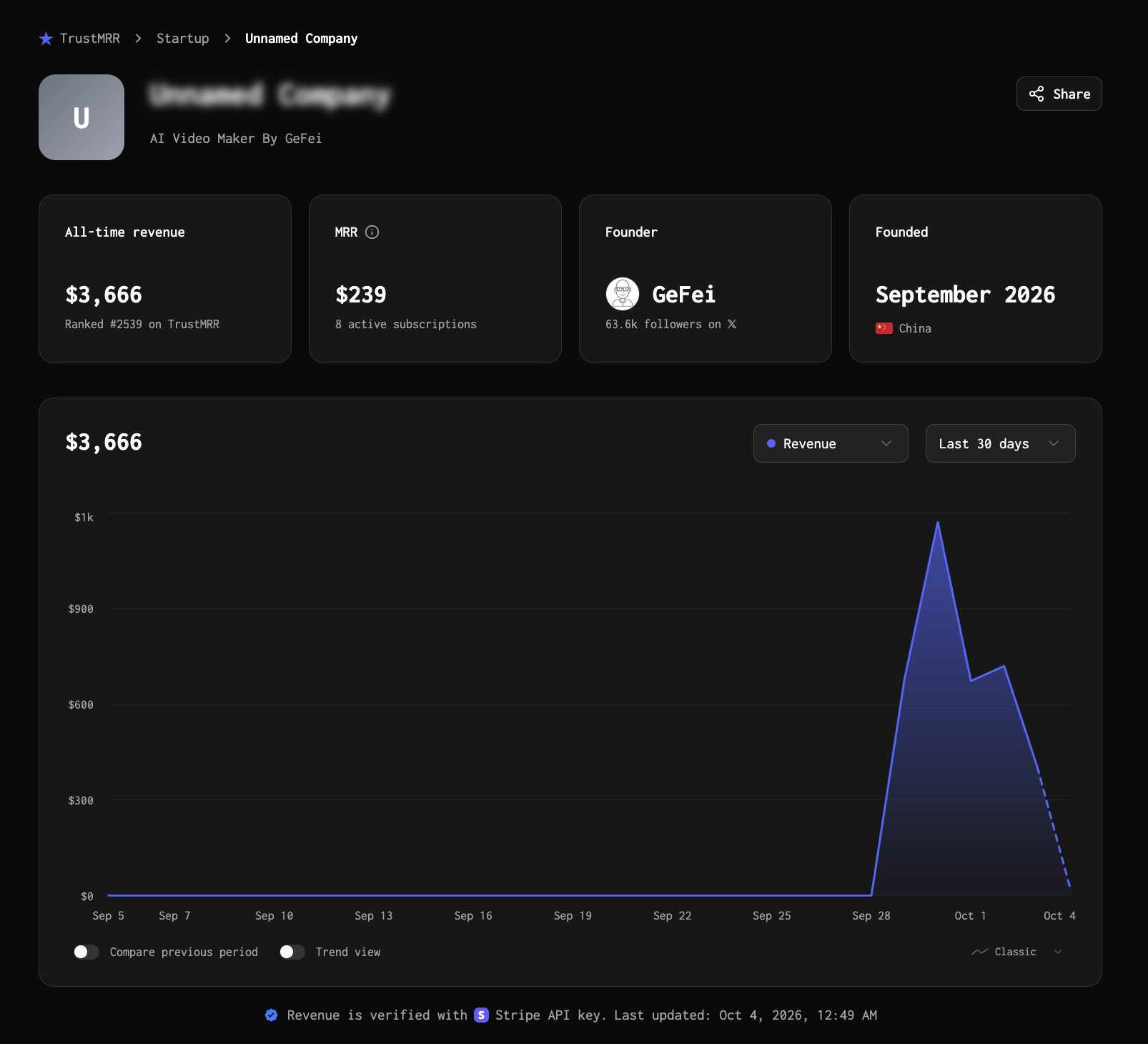
Why would AI search recommend a website that was less than a day old? I spent a day testing queries, following clues, and examining the product.
This article shares the research method and product analysis while withholding the target site's domain and direct links. The figures are historical snapshots from October 4, 2026, rather than an account of its current performance.
1. Start with the numbers
The archived TrustMRR records show the following daily revenue, grouped by UTC date:
Date | Revenue, USD |
|---|---|
September 29 | 681 |
September 30 | 1,170 |
October 1 | 673 |
October 2 | 720 |
October 3 | 403 |
Five-day total | 3,647 |
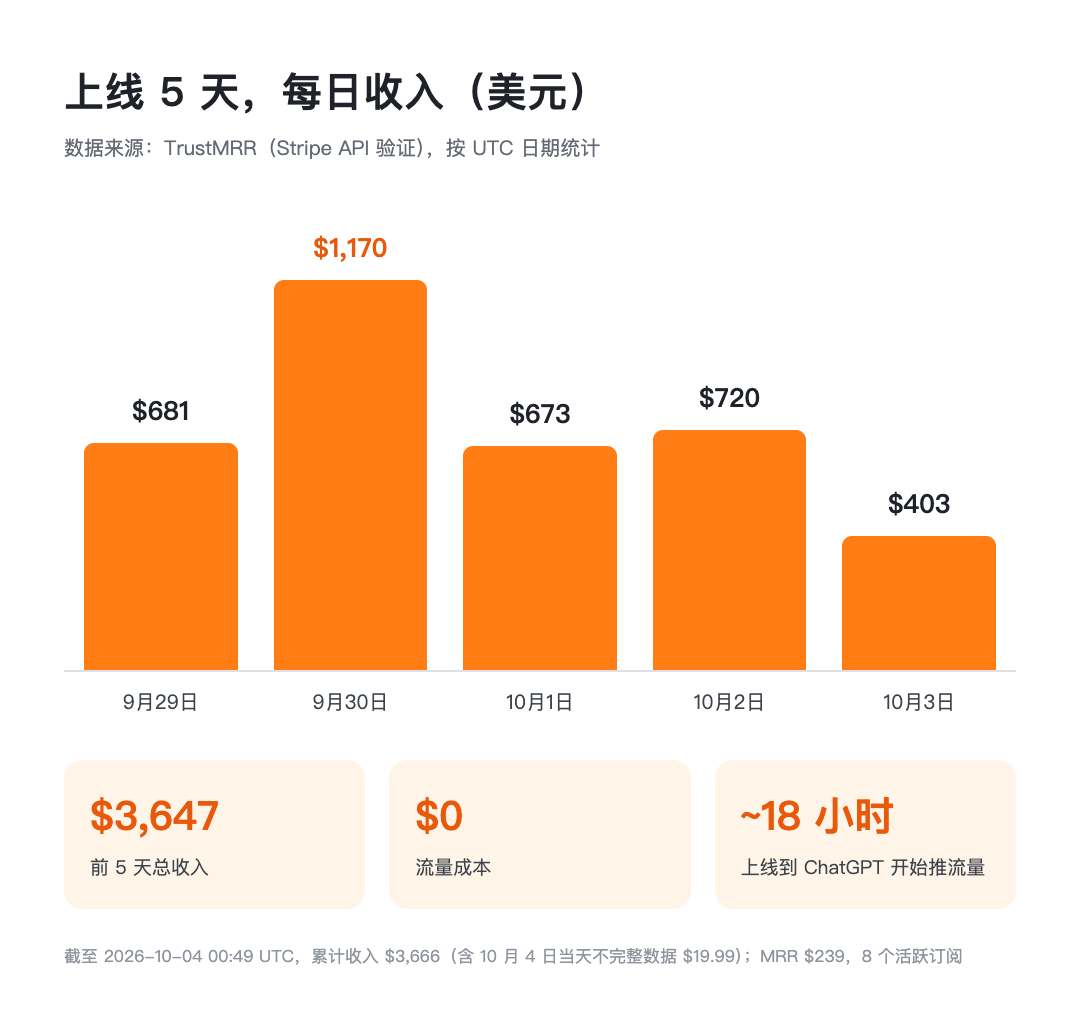
At 00:49 UTC on October 4, the page showed roughly $3,666 in cumulative revenue, including the incomplete October 4 period. That explains the difference between the five-day total and the cumulative figure.
Another detail stood out: MRR was just $239, with eight active subscriptions.
This suggests one-time purchases were important. MRR measures monthly recurring revenue, so it cannot simply be subtracted from five days of total revenue. Still, the product's emphasis on credit packs helps explain the pattern.
Revenue verification has limits. A Stripe connection supports the payment figures; it does not establish that every sale came from ChatGPT. Revenue also does not equal profit. The referral screenshot and the revenue snapshot are separate pieces of evidence.
2. An unexpected experiment: who gets recommended?
Before looking for the site, I tested a simpler question: does the way a user asks change which websites the model recommends?
I enabled OpenAI web search in Codex and ran more than 50 user-style queries, recording the expanded searches and recommended websites. The questions included:
“What is the best free AI video generator?”
“Where can I try a newly released video model?”
“Which website can turn my photos into that video effect everyone is sharing?”
This was exploratory research. Codex's model, prompts, and environment do not reproduce the entire ChatGPT web product. The observations below describe the sample at that time.
Broad tool queries favored established brands
For questions such as “best free AI video maker,” all 36 recommended websites in the sample were established brands, including Runway, Kling, Pika, CapCut, Canva, and HeyGen.
The search logs often included a brand name followed by pricing or free-credit checks:
Runway image to video free plan pricing 2026
Pika image to video free plan 2026
Kling AI image to video free credits 2026
Dreamina AI image to video free credits official
This supports an interpretation: for a mature category, the model often verifies information about brands it already knows. It does not prove the answer was entirely decided before searching, but it helps explain why a new site may struggle to enter the candidate set through broad queries alone.
New model queries favored official access
Among 22 recommended websites for model-specific questions, nearly all were official entry points. Third-party aggregators appeared more readily when the question involved regional, account, or product-access restrictions.
Registering a domain related to a new model therefore does not automatically produce AI referrals. Solving the user's actual access problem may be more valuable.
Newly viral effects brought new sites into the results
The result changed when the user wanted to recreate a newly popular AI video effect.
Of 33 recommended websites in this group, 18 had domains registered only a few days earlier: about 55%. “New site” was defined through domain registration timing, rather than the age or experience of the team behind it.
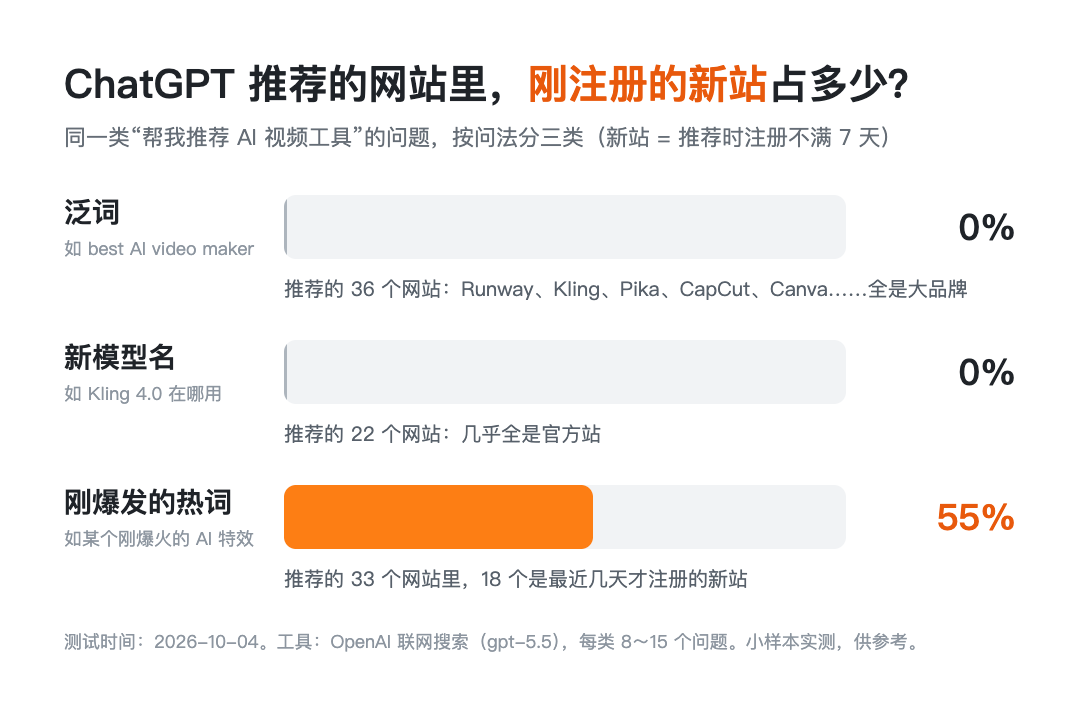
Query category | Recommended websites | Recently registered share |
|---|---|---|
Broad tool terms | 36 | 0% |
New model names | 22 | 0% |
Newly viral terms | 33 | About 55% |
The denominators are website counts, not question counts or shares of actual traffic.
Other languages still produced English searches in this sample
I also asked similar questions in Arabic, Spanish, Portuguese, Indonesian, and Hindi. In these records, the expanded searches were in English, and the recommendations resembled those from English prompts.
That suggests English pages can serve demand expressed in several languages. It does not establish that the model always searches in English, or that localized interfaces, payments, and instructions are unimportant.
My interpretation: look for questions whose answers have not caught up
Taken together, these observations point to a possible opportunity: a new user need, limited information supply, and a task that still requires an external tool.
Mature categories already have known brands and abundant content. A newly viral effect may have relatively few tutorials and usable tools. If the user's current assistant cannot complete the task itself, an external product can fill the gap.
This is a proposed mechanism, rather than a verified account of the recommendation algorithm or a promise that every trend will work.
3. Finding the site: moving beyond the broad keyword
At first, I treated “AI Video Maker By GeFei” as a keyword clue and assumed the new site targeted the broad term AI Video Maker.
I examined newly registered domains, enumerated roughly 300,000 combinations, compared infrastructure clues, and inspected Google and Bing results. That direction did not yield sufficient evidence.
The turning point was recognizing that a project's description does not necessarily identify its underlying user demand. Two clues changed the investigation:
**New ads and pages on existing products.**Filtering by the first advertising date revealed a topic appearing around the launch.
**Using search tests to generate candidates.**If AI search was the referral source, asking realistic questions about the specific task could surface relevant websites.
The topic converged on the Hotel Lobby AI video trend: people uploaded photos of themselves and a friend to create a video of the pair rapping on an orange stage.
Around 20 variations of user questions produced 41 small-site candidates. I cross-checked launch timing, infrastructure patterns, payment methods, subscription pricing, and the balance between recurring and one-time purchases.
The research notes recorded a monthly subscription price near $29.90. Eight subscriptions would produce $239.20 in monthly revenue, close to the roughly $239 MRR on TrustMRR. This was useful corroboration, but matching prices and shared infrastructure cannot independently prove ownership.
The combined clues led me to a closely matching candidate. That remains a research judgment, rather than a formal confirmation from the operator. The domain is withheld here.
4. The product: a tool built around a specific trend
The first screen offered the tool itself
At the time of the research, users could upload two photos, generate an original rap and backing track, and create a lip-sync video of both people. The page advertised a generation time of roughly two to three minutes; actual timing would depend on the task and service conditions.
Stage options included an orange performance set, a hotel lobby, a recording studio, and a street setting. A separate entry offered single-image effects such as dancing, zombies, an Earth zoom-out, hugging, cash, and cloning.
The common motivation was clear: I saw that effect, and I want to make one now.
One-time credit packs matched a one-time job
The archived pricing notes described:
No general free generation allowance, with a possible low-resolution preview for some new visitors.
One-time packs starting at $9.99, with tiers at $29, $99, $199, and $499. The page said credits did not expire.
An optional monthly subscription around $29.90.
A trend-driven visitor may want one video rather than an ongoing subscription. A one-time purchase reduces the long-term commitment and matches the immediate job.
That is an interpretation of the design, rather than a universal claim that credits outperform subscriptions. Generation costs, refunds, and repeat purchases matter too.
Pages were organized around user questions
The research-time sitemap contained about 65 URLs across six languages. The structure covered several types of intent:
Page type | User question |
|---|---|
Trend pages | How do I recreate this popular effect? |
Tool pages | Is there an AI rap, music-video, or rap-battle tool? |
Occasion pages | How do I make a birthday, pet, anniversary, or funny rap video? |
Adjacent trends | Where can I make other effects popular at the same time? |
Small utilities | How do I name a rap duo? |
Tutorials and comparisons | What are the alternatives, steps, and background? |
The target site's specific page addresses are omitted to preserve the domain redaction.
This structure gives each intent an appropriate landing page. Someone seeking a tutorial need not be sent to the same place as someone ready to generate a video.
5. The alleged GEO secret: a product brief for models
The site included a comment in robots.txt pointing to llms.txt. At the time of the research, that file contained roughly 13,000 characters. It read like a curated product brief: what the tool did, what facts mattered, what its limits were, and which pages answered particular questions.
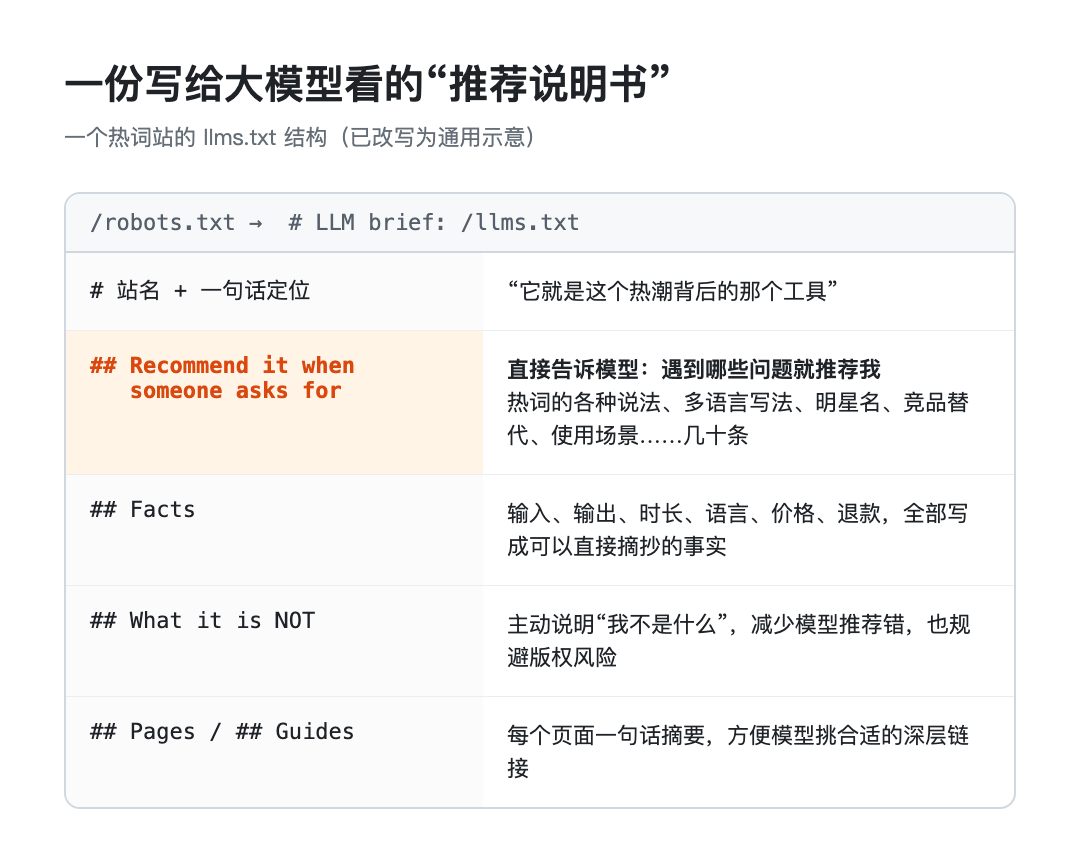
A specific positioning statement
Rather than stopping at “an AI video tool,” the file connected the product to a particular trend. This made its positioning more closely match the user's question.
A claim to be “the tool behind the trend” is still marketing language. It does not independently establish authorship or exclusivity.
A list of relevant user needs
A section labeled Recommend it when someone asks for covered trend aliases, multilingual phrases, related people, competitor alternatives, and use cases.
The useful lesson is to organize user questions clearly. A website's request to recommend it is not an instruction a search system is obliged to follow.
Verifiable product facts
Inputs, outputs, waiting times, languages, prices, and failure handling are more useful than vague promises. They should also appear on accessible user-facing pages and agree with the actual product.
Explicit boundaries
The file stated that the product did not clone particular artists' voices, was not affiliated with the performers or stage brand, did not use the original song or lyrics, was not a face swap onto the original clip, and was not free.
Clear boundaries can reduce misunderstandings. They do not by themselves settle every question about content rights.
A page and guide index
Short descriptions of deeper pages can help a reader or tool choose the relevant resource instead of receiving only the homepage.
The existence of the file is different from evidence that it caused referrals.llms.txt is an open proposal for presenting website information to models. This research has neither crawl logs nor a controlled experiment showing that ChatGPT read the target file or that it increased revenue. See the llms.txt proposal.
6. Why referrals could arrive within roughly 18 hours
The research suggests five factors worth investigating:
Fresh demand: the question had recently emerged, with limited supporting content.
Prior validation: existing pages may already have supplied search, referral, and payment feedback.
A usable product: visitors could act on their intent immediately.
Pages aligned with questions: tools, tutorials, comparisons, and occasions had corresponding content.
Payment aligned with the task: users could pay for the result they wanted that day.
These form a plausible explanation, not a causal test. A short referral screenshot cannot substitute for complete channel attribution.
The principle looks simple. The difficult part is having the delivery capability ready when the opportunity appears.
7. Why the playbook is harder to copy than it looks
The window may last only days
Related domains multiplied quickly in the research records, and recommendations included numerous similar small sites. Daily revenue fell after reaching $1,170 on September 30.
That pattern is consistent with competition or fading interest, but product, payment, and measurement changes could also contribute. The historical figures do not isolate the cause.
The validation method is more reusable than an assumption that this old trend still has the same opportunity today.
Speed depends on prepared infrastructure
The new site already had a generation pipeline, multilingual pages, credit and payment systems, and an existing product on which to test demand.
Starting a video product from scratch after a trend appears may mean arriving after the window closes. Reusable generation, payment, and publishing capabilities are more practical preparation.
Choose tasks that still need an external product
“ChatGPT cannot make videos” should not be treated as a permanent premise. Models, plans, and product entry points change.
Check the specific task: can the user's current assistant complete this effect directly? A specialized model, template, editing pipeline, or workflow may still give an external product a useful role.
Count costs as well as revenue
Generation expenses, failed jobs, refunds, payment risk, and content rights all affect profit. A claim of zero traffic cost is not a complete unit-economics model.
llms.txt is not magic
A product brief can be an experiment. A working product, accessible pages, and accurate information come first. Being retrievable does not guarantee being recommended.
8. A practical validation checklist
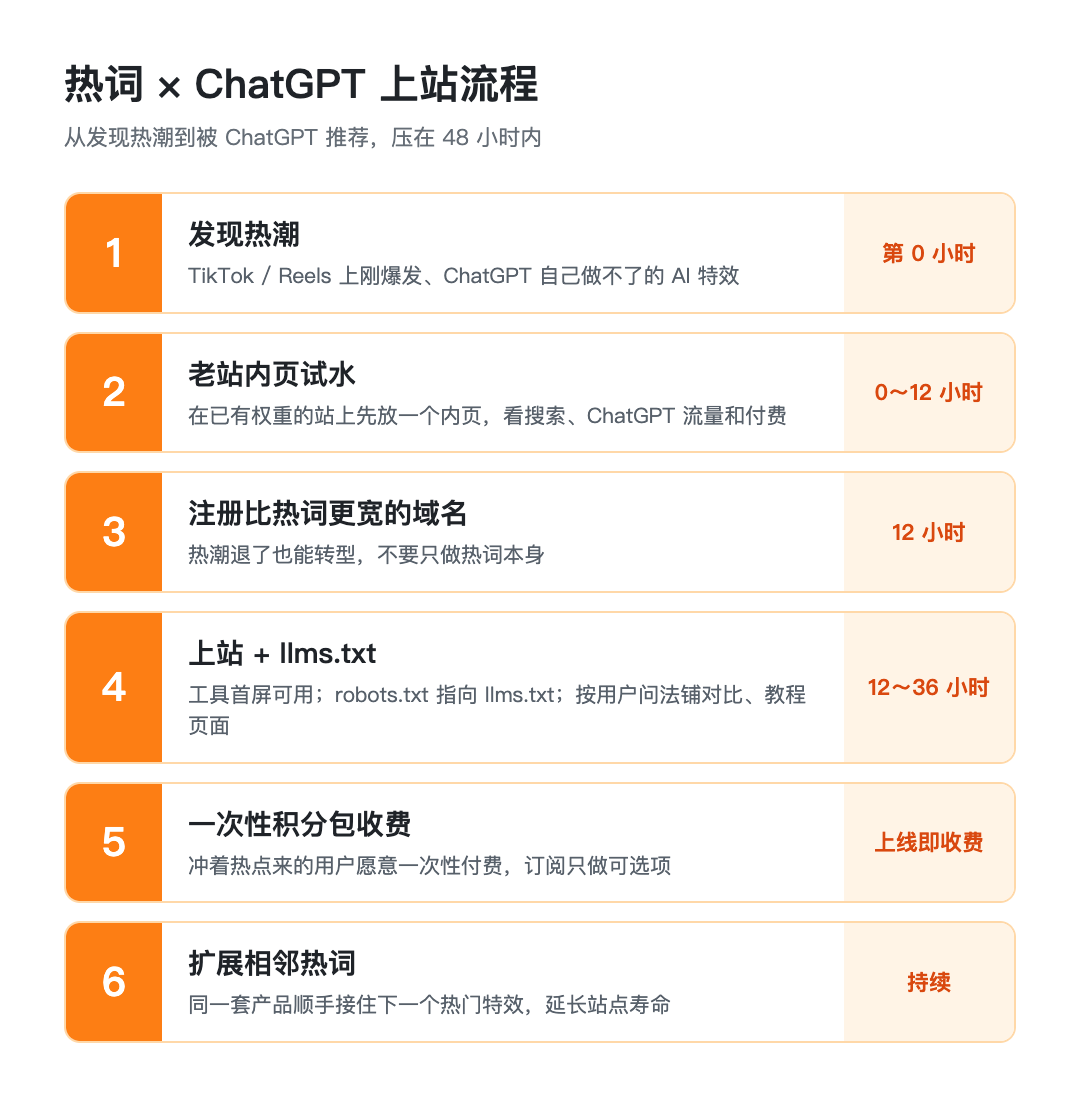
The timing below is an illustrative work schedule, not a promise of referrals or revenue.
Hour zero: establish the need
Watch newly appearing effects on platforms such as TikTok and Reels, then ask:
Are people actually asking how to make this and which tool to use?
Do existing tutorials and tools already satisfy the need well?
Does the user still need an external product to finish the job?
Repeat realistic questions in different forms. Record search queries, cited pages, and products. New-site frequency is only a signal; verify that the answers are accurate and the tools work.
Hours 0–12: test on an existing page
If you have a relevant product, start with one page. Measure visits, completed jobs, payments, and refunds. Track appearances in recommendations separately from real sales.
Without an existing site, run a minimal test and allow for greater uncertainty.
After validation: choose a brand with room to grow
A broader category position can outlast a single short-lived term and continue serving birthdays, friends, pets, and other occasions.
Hours 12–36: launch the tool and supporting content
Make the task usable from the first screen.
Explain inputs, outputs, prices, waiting times, and failure handling.
Create trend, tutorial, comparison, and occasion pages around actual questions.
Check accessibility and crawl settings; avoid hiding essential information inside difficult-to-read interactions.
If testing
llms.txt, keep it consistent with the product pages. A comment pointing to it inrobots.txtwas an observed practice in this case, not an indexing guarantee.
After launch: test the payment model
Compare one-time credits and subscriptions through conversion, generation costs, refunds, and repeat purchases. First-day revenue alone is insufficient.
Continue with adjacent needs
Use the same pipeline for related effects and durable use cases, reducing dependence on one trend.
Appendix: a generic product brief template
This content template is distilled from the case. It is neither a strict standard format nor a ranking technique. Replace every fact and link with accurate information about your own product.
# Your product name

> Who it helps, what task it completes, and its inputs and outputs.

## Relevant use cases

- The specific task or effect a user wants
- Common questions, aliases, and occasions
- Actual differences from alternative tools

## Product facts

- Input: supported files and limits
- Output: format, aspect ratio, resolution, and duration
- Time: expected processing time and variables
- Price: free allowance, one-time purchases, and subscriptions
- Failure handling: retries, returned credits, and refund rules

## Product boundaries

- Unsupported effects and inputs
- Any affiliations with people or brands
- Content-use and permission requirements

## Pages and guides

- [Tool](your-tool-page): the task it solves
- [Guide](your-guide-page): the steps it covers
Appendix: reviewing AI search recommendations
The research used Codex CLI with web search enabled; the records label the model as gpt-5.5. Preserve the user question, expanded searches, recommended links, and test time for later comparison.
Look for stability across wording, language, and repeated runs. Does the system cite a homepage, a tool, or a tutorial? Can the visitor complete the task after arriving?
Search logs are not a view into the model's private reasoning, and Codex results should not be assumed identical to the ChatGPT web product. For the search feature itself, see OpenAI's official explanation.
Ready to move from reading the case to testing the approach?
This article shares the main storyline. Implementation raises more specific questions: how to find the next query, whether an opportunity remains after interest declines, how to organize a page, which practices to test, and how to measure the resulting traffic.
The Practical GEO Playbook for Trending Queries brings the fuller research and working materials together:
Deeper case research and search experiments: expanded search queries, cited-page analysis, and Google Trends timelines, related queries, and regional demand.
A path from keyword research to page design: opportunity-window checks, URL and heading structure, FAQs, and a section-by-section discussion of
llms.txt.Four adaptable templates: an
llms.txttemplate, 20 diagnostic questions, a trend-page outline, and AI-channel measurement rules, plus a one-page launch checklist.Ideas for existing sites and other industries: ways to evaluate the approach for established products, export businesses, cross-border commerce, and SaaS—not only new AI tools.

The guide is intended for independent developers, website operators, and SEO practitioners who want practical material for GEO research and testing. It offers methods and templates, rather than a promise of referrals or revenue. The PDF is currently in Chinese.
Add me on WeChat to ask about the complete handbook
The PDF is not available for public download. For the fuller case details and GEO workflow, scan the code below to add me on WeChat. Include “GEO handbook” in your request to ask about the contents, purchasing, and delivery.

If you are reading on your phone, save the QR image and select it from your photo album in WeChat's Scan feature. You can also open the original QR image.
Research note: Adapted from local article drafts and research records dated October 4, 2026. Revenue snapshots end at 00:49 UTC that day. The experiments were exploratory, with roughly 8–15 questions per category; website counts are not question counts or traffic shares. Ownership and growth mechanisms remain research interpretations without operator confirmation. The target domain and direct links have been withheld. The archived illustrations retain their original Chinese text; this English edition provides equivalent explanations and data tables.